Last year’s reading project was to re-read classics I had read in my twenties. I failed. I made several attempts, but once I finished The House on Mango Street, the memories flooded back. I realized my twenties were not a time I wanted to relive, and the project kept getting postponed, stacked on my bedside table. Books with bookmarks at page five, seven, nine could be found on most tables in my house.
Yesterday I picked up one of those books and finished it. It all started with the book I’m currently reading, Chain-Gang All-Stars by Nana Kwame Adjei-Brenyah. I’m 10-12 pages away from the denouement, and I don’t want to finish reading this book. It’s just too good, and I’ve grown so fond of our time together. I’m not ready to let go. I needed something in between to engage the reading impulse Chain-Gang spurs without using up Chain-Gang. I remembered last year’s project.
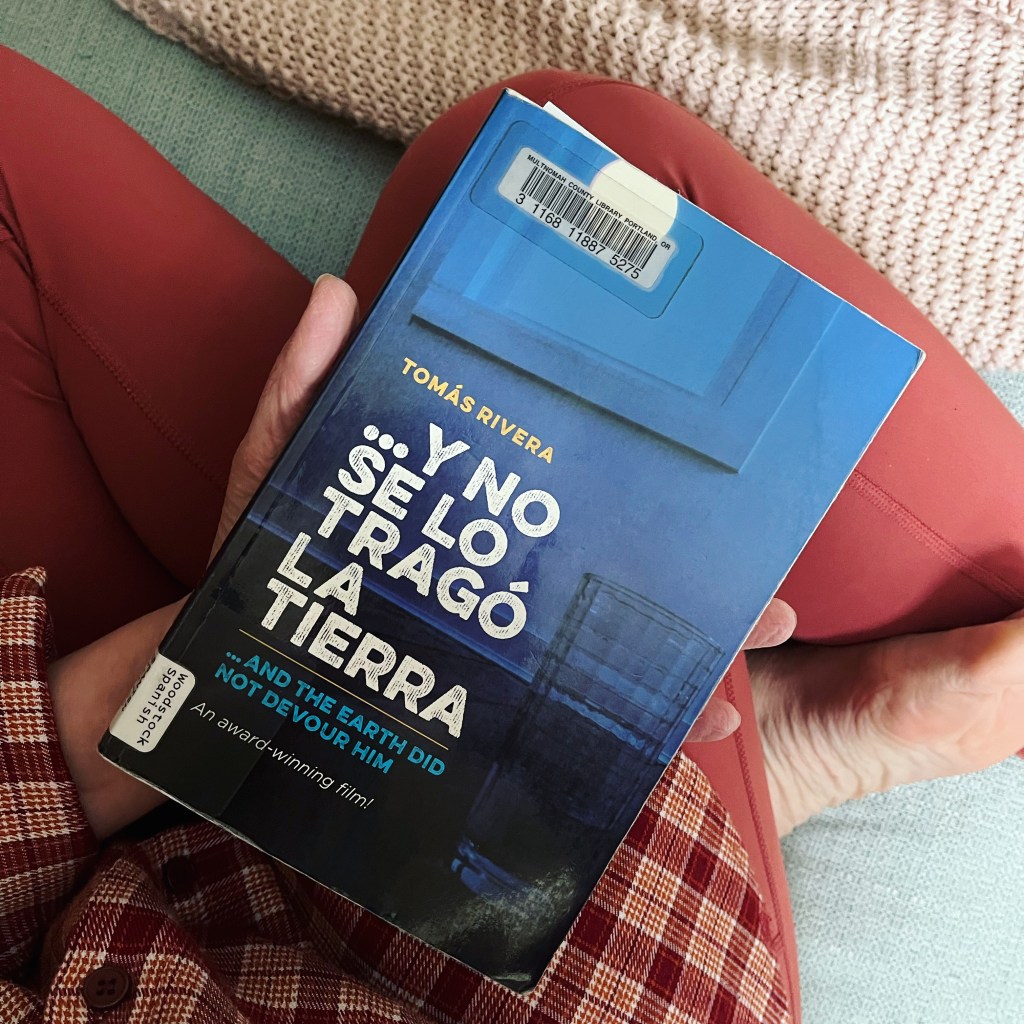
Neatly stacked with all my overdue library books, I found …Y no se lo tragó la tierra by Tomás Rivera, a book I read in 1992 for my Chicano Literature class. I like to say that this book saved me, but it feels ridiculous to say something like that at my age when I know how many times I fell apart and pulled it together in later years. When I was 23 years old, it definitely felt like my life had been saved.
I had failed out of college a year before, and when that happened I figured that was that. It had become impossible to go to class, read, complete assignments. I woke up every day and drove to school, but somehow I was frozen in front of a really large television in the student center. I watched soaps and daytime talk shows, and then when my classes were over, I drove home. Do that long enough, and you get a letter telling you to stay home and not bother.
About nine months into my failed year, a neighbor saw me walking and called me over. His name was Benito. He was a poet from Puerto Rico, and he said, “I noticed you’re not going to school anymore.” We had never talked before this day, but he spoke to me in Spanish. What part of my story had made it out to him? What pieces of my puzzle were so obvious to a passing stranger? I didn’t even know his dog’s name or which mailbox was his. He heard my story of failing out, and he had a solution. “Go back to school and take classes in the Spanish Department. You need to connect to your culture. The secretary in the Spanish Department is a poet. Go talk to him and tell him I sent you. He will help you. You need to connect to your culture, and you’ll graduate.”
I did what he said. He gave me a checklist, I checked the boxes, and soon I was in classes again. This time, though, all my classes were in Spanish, the books in Spanish, my classmates spoke Spanish. I still didn’t get what he meant about my culture because the only Argentine we read was Borges, and he’s not the best communicator of the Argentine experience. And then I took Nicolás Kanellos’ class on Chicano Literature. I read …Y no se lo tragó la tierra. I have nothing close to the migrant farmer experience in my life, but the alienation, the way my identity was held up to me through a distorted mirror, that I could understand. I had a language to speak my life.
Last night, when I read this book again, what came back to me was the thrill of discovery. I spent that first year back in college discovering that I wasn’t alone, and this was news for me. This book sent me to the library to research who had read it and what they had said about it, and the library, this block of a building in the middle of campus, had piles of articles and books with more stories like this one. I had been numb and waiting, and now I was searching.


 febe reads
Leave a reply to febe2 Cancel reply