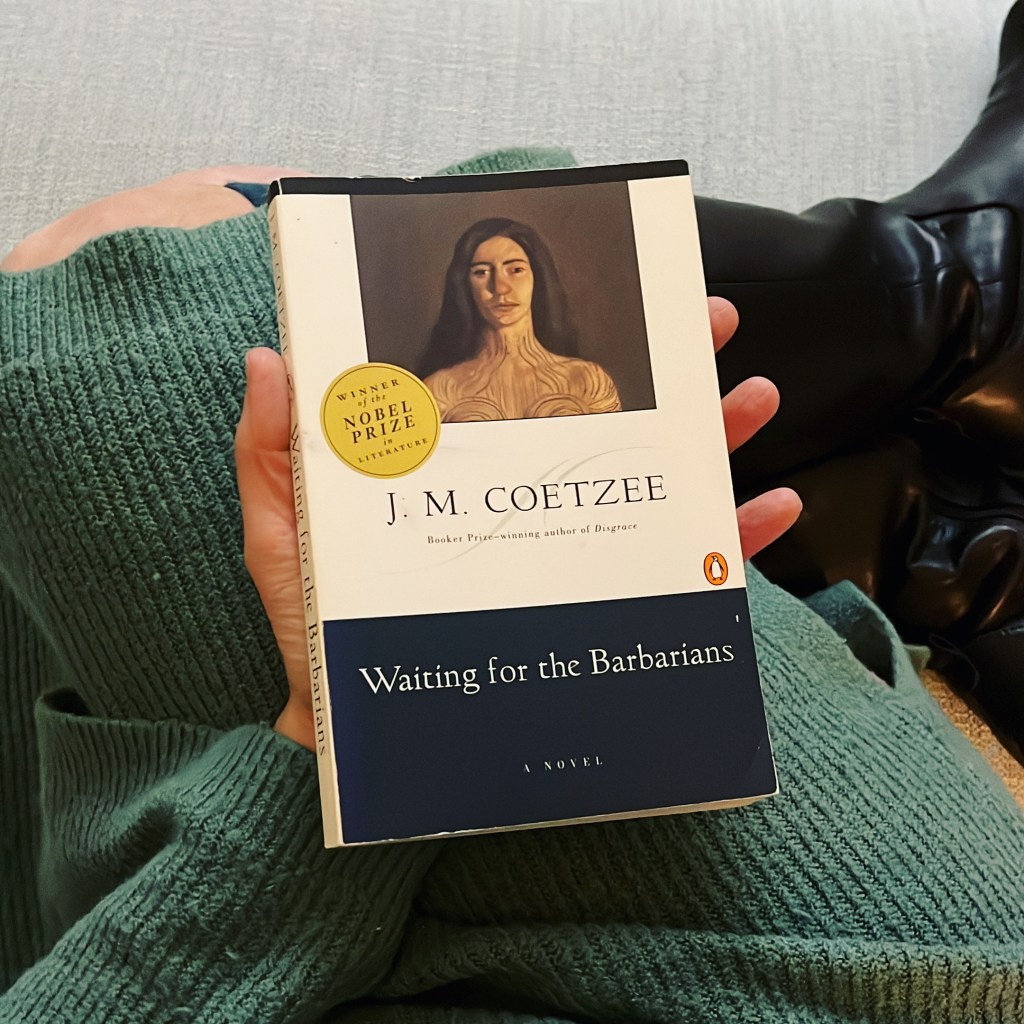
Sometimes I’m more fascinated by how a book made it to me than what I learn in reading that book. Most people read Waiting for the Barbarians by J. M. Coetzee in college, but I found it in The Sentence by Louise Erdrich. Tookie, the main character, works at a bookstore, and she and a regular customer make a list of books that “knock you sideways in around 200 pages.” I snapped a picture of the list and within a week I had picked up the books. The thirteen books made a neat little pile just under a foot, and now I faced a moral dilemma.
I was reading Erdrich because she’s a great storyteller and because she’s a Native writer, and now, her very own list in her book was pointing me to mostly White writers. I choose works by non-White authors to broaden my perspective, to step outside all the forces in our world that make it feel like White is normal and obvious. I know that if I don’t pay attention to my reading diet, I’ll end up repeating stories and realities that are overly familiar to me. I need regular connection with stories by Latino writers because that mirrors my identity, and I also need branches to other folks in the periphery. I learn how to navigate and understand this world when I focus my reading on characters who codeswitch, undermine, upturn, endure, redefine. And now, here was Erdrich saying Denis Johnson! Joseph Conrad! William Kotzwinkle! Seriously, woman?
But my love for the short text begged me to reconsider. I like to hold a book in the palm of my hand and lift it up and down. Could I hold this book in one hand while my other arm is wrapped around a bus handgrip? Could I lift the book to my eyes with one hand while the other one is flipping a pancake? These are the books that win out when I’m choosing a good read. Anything over 400 better be in some end of the year top ten list or I cannot be bothered.
Sula by Toni Morrison made Erdrich’s list, and I thought it would be an acceptable start. Too Loud a Solitude by Bohumil Hrabel, a Czech writer and First Love by Ivan Turgenev had some degree of marginality, being Eastern Europeans. Maybe. But then when I lost myself in Train Dreams by Denis Johnson, I had to reconsider my oversimplified writer protocol.
It’s useful to have straighforward, non-negotiables when it comes to choosing a book. Some people never read books with dragons in them, and some only dive in for romance, but I truly delight in letting another reader’s preferences influence me, and I wanted to let Louise Erdrich get into my imagination with her curiosities and questions.
She took me far away to a desert in Waiting for the Barbarians, to walk with a desperate man who thrived in Empire and then became a beggar. He said to us, “Perhaps this escapade has not been futile if I can recover, however dimly, a spirit of outrage,” and I wanted to punch him in the face and tell him to get angry already. He only became more desperate, more wretched, and at this point, I realized this wasn’t Louise Erdrich’s list, this was Tookie’s list. Erdrich had extended her book through these thirteen short novels to walk me through all of what made Tookie Tookie.
 febe reads
Leave a comment